
Living in Indonesia

MFA eRegister
Living in Indonesia
Do I need a visa or work permit to work in Indonesia?
Yes. To legally work in Indonesia, you need a work permit (IMTA) and a Limited Stay Visa (KITAS) sponsored by your employer. Tourist or business visas do not allow you to work.
What is the cost of living in Indonesia compared to other countries?
Indonesia is generally affordable. Monthly living expenses range from SGD 600–1,200 depending on lifestyle and city. Jakarta and Bali are more expensive, while secondary cities (Surabaya, Yogyakarta, Medan) are cheaper.
What is the working culture like?
Workplaces are often hierarchical, with respect for seniority and decision-making usually top-down. Building personal relationships is important, and communication tends to be indirect and polite.
How is healthcare in Indonesia?
Private hospitals in big cities (Jakarta, Bali, Surabaya) provide good care. Many expats use international health insurance and may travel to Singapore or Malaysia for complex treatments.
Is Indonesia safe for expats?
Generally yes. Violent crime is rare, but petty theft and scams can happen. Traffic accidents are a bigger risk. Political protests occasionally occur but are usually peaceful.
What lifestyle can I expect?
Indonesia offers a mix of modern and traditional lifestyles: vibrant cities, tropical islands, rich culture, and diverse cuisine. Social life for expats is active, with communities in Jakarta, Bali, and other hubs.
Feature Articles: Singaporean Living in Indonesia
Nicholas Wu: Enterpreneur and Content Creator
Sleeping at Petrol Stations and Creating Content: How a Singaporean Entrepreneur Found His Voice in Indonesia
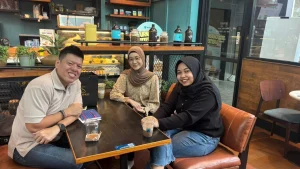 Image: Nicholas Wu & SAI Team during Interview Session
When Singaporean entrepreneur Nicholas Wu (@paknicaman) first moved to Indonesia, he wasn’t chasing a dream of luxury or status. He came with a simple question: “If not now, then when?”
Raised in a humble family in Singapore, Nicholas’s early life was marked by doubt from others and low academic performance. “People used to tell me, ‘You’re going to be a failure,’” he recalls. But even if he wasn’t the top student, Nicholas had something else, the ability to connect with people. That gift, paired with determination, would later define both his business and his identity.
Journey with Aman Logistic
Aman Logistic is a family business started by Nicholas’ parents and him in 2000. After he comeback from the army training in his 20s age, he started to work in his parents company doing heavy work first, such as became the driver, but then became in charge as a Manager in Singapore to overlook the operation in Indonesia.
Years later, after managing operations in Singapore, Nicholas proposed to his father that he relocate to Indonesia to oversee the company’s expansion firsthand. His father initially disagreed, worried about the challenges of working abroad. Nicholas also doubted himself at first because he already had a stable life in Singapore, but something inside him pushed forward.
“I told myself, if not now, then when? That’s how I decided to move.”
Culture Shocks and New Beginnings
Nicholas’ first 2 years in Indonesia wasn’t an easy journey for him. He needs to familiarize himself with the different cultures and values that most Indonesians held. As a Singaporean who used to very obedient with the laws, he was shocked by how Indonesians are so very prone to breaking general laws, such as traffic regulations. Aside from that, Nicholas who used to had on time schedule in Singapore, he also need to familiarize himself with the “late” culture in Indonesia.
But for every challenge, there was a discovery. He was deeply moved by Indonesia’s sense of gotong royong, the spirit of communal cooperation and the way people begin gatherings with prayer.
“At first, I found it strange,” he admits. “But I realized it’s about gratitude and asking for blessings for what’s ahead. Because we do not know what’s the path going to be like, whether it’s going to rain, whether it’s going to be like that. It’s something uncommon to do in Singapore.”
Leadership and Entrepreneurship
Nicholas thinks that all humans have their own respective experiences that are equally valuable. Based on his considerable background where some of people often look him down, this made him grow into a humble person who appreciated others more–not excluding his staffs. He is willing to listen to the input and experiences shared by his staff. Therefore, this become an advantage because he gains a better understanding of the thoughts of those in positions below him.
More than that, Nicholas admits that he does not like to be called as a “Boss” because it would made him more superior than the other. He would rather to be called as “Pak” since it still respects him as a leader, but keeps him on an equal level with his staffs.

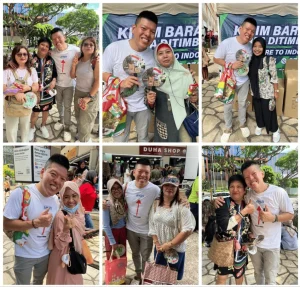
Image: Nicholas Wu and His Customers
One unique story of Nicholas leadership journey is that he tried to follow his company driver’s in delivering goods to the rural areas in Central & East Java. Instead of his driver is being asked to adjust his lifestyle to make the boss comfortable, it was rather Nicholas who to adjust his lifestyle to suit the driver’s way of life. He tried to survive on the streets and slept with his driver at a petrol station for four days straight.
Even though he feel scared, he quoted that, “What doesn’t kill you make you stronger.”
He stated that the reason why would he did the 4 days trip on the road is to understand the struggle involved in delivering goods to customers. He also thinks that it would make him more humble and feel closer to his drivers. Other than that, by doing the 4 days trip and documented it in his contents on social media, Nicholas believe that it would be a good way to show loyalty and grabs his customers’ hearts by showing that the boss himself is involved in the delivery process.
From Entrepreneur to Content Creator
Two years ago, Nicholas began posting videos to promote Aman Logistics on TikTok. Initially, his goal was purely business: to humanize the brand through storytelling instead of hard selling.
“Most companies say, ‘Drink this coffee!’ I prefer to say, ‘Why is coffee important to your day?’”
However as the time goes by, Nicholas realized that he actually has an unique selling point that make him different than other creators because he is a Singaporean living in Indonesia and he likes to tell his daily life story in the contents. In process of making his contents, Nicholas stated that he do not prepare any script. He just went from one line in the beginning of the video as a hook and then develop it into an interesting story.
For example, Nicholas just casually see a guy on the road that doesn’t wear a helmet and then he feel frustrated. Then, he would asked himself with these kind of questions before producing his content,
“How do I tell a story?”
“How do I make it interesting?”
Even though the beginning of his content creation journey only attract 30 viewers, Nicholas is a hard worker and discipline person. He try to consistently post 12 videos per day so that out of those 12 pieces of content could have a greater chance of being featured on FYP.
Lesson & Advice for Fellow Singaporeans
In the end of the interview, Nicholas emphasized the importance of embracing Indonesia for the Singaporeans living in Indonesia. Do not act like a Singaporean in Indonesia because you need to learn and adapt.
About Nicholas Wu

Founder & Managing Director, Aman Logistics
Content Creator | Instagram: @paknicaman
Nicholas Wu is a Singaporean entrepreneur based in Indonesia. Through Aman Logistics and his storytelling on social media, he shares lessons about leadership, culture, and perseverance while bridging two worlds: Singapore’s precision and Indonesia’s warmth.
Damien Koh: Entrepreneur in F&B Business
From Joe & Dough Cafe and Kooma Japanese Bakery: A Journey of Damien Koh on Building Business
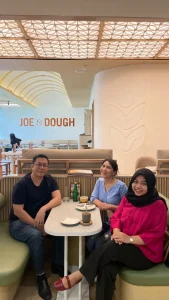
Image: Damien Koh & SAI Team at Joe & Dough Plaza Indonesia
Before entering the F&B industry, Damien initially planned to start a bungee jumping business in Singapore. However, it turned out to be a far more complicated process than expected. He had to deal with 11 different government agencies and go through years of paperwork, safety clearances, and submissions.
While waiting for the bungee jumping project to be approved, Damien decided to take up a part-time job at a small cafe. What began as a temporary side job gradually turned into something more serious
Early Journey on F&B Business
Damien began his first steps in the F&B industry as a part-time staff member in a small cafe. Eventually, he ended up managing the entire place, and his former boss invited him to become a business partner. Their first idea was to sell local coffee and mie goreng at a small kiosk in Suntec City’s food court. The business targeted office workers and ran successfully for about two and a half years. But then Damien started to think,
“What’s next?”
He wanted to build a business that can scale
At that point, Damien told his partner that he wanted to start something on his own. So, he sold his shares back to her and left the old business. He then decided to build a new venture with his girlfriend—now his wife—focusing on his passion: the coffee industry. That was how the first Joe & Dough outlet was born in Singapore.
However, Damien soon realized that the coffee industry was highly competitive, with many established players. He recalled, “Even if I sell 200-300 coffees with rental and staffing, we are not going to make money. So financially, it didn’t make sense to me”.
He also noticed that coffee is kind of difficult to differentiate and hard to explain to most of people. That’s when he decided to sell sandwiches alongside coffee at Joe & Dough, to make his business stand out among other cafes.
Although his journey in opening his first outlet wasn’t smooth, Damien managed to open his second outlet just one and a half years span from his first outlet opening. It was an inquiry from Damien’s friend that interested in what he did with Joe & Dough. Not a norm for a normal business, Joe & Dough second outlet was a franchising.
Expanding to Indonesia
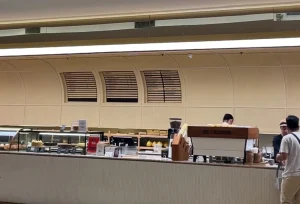
Image: Joe & Dough Cafe at Plaza Indonesia
After thriving in Singapore for 17 years, Damien wanted to expand his business overseas. He began exploring different markets. For him, the most important criterion for going overseas was finding the right partner. As he said, “That’s top criteria because no matter which market that you go to, if you don’t have the right partner, its not going to work anyway. Even if you go to a very good market and the partner is very poor, you know it’s not going to work. I’d rather have a smaller market and sincere partner because it’s going to work.”
Second criteria coming from him is that he prefer a big market size. This is due to a small team he has, so there is always opportunity cost of time. He said, “There is a lot of effort that you need to spend to go overseas. There is a lot of cost to transfer knowledge and IP. If you go to a country and you cannot open enough outlets, actually it’s hard to sustain that cost of transfer”.
The third criteria is a the market fit, is the brand he bring to this country suitable with the market? Damien recounted that when he entered to Indonesia 7 years ago, it’s not like current condition when Indonesia are filled up by various type of cafes. “If you remember last time, there are a lot of cafes but no bakery cafe. We are one of the first few that does the modern version of it. There were some bakery cafe, but more European format and they don’t really have a modern bakery cafe. So we thought that Indonesia with a big and growing middle class and people are looking for something like this. So we thought that there was a product fit in the market and that’s why we decided to come to Indonesia,” He explained.
From Joe & Dough to Kooma Bakery
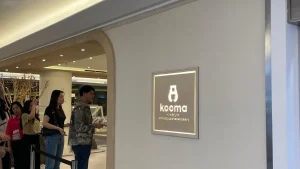
Image: Kooma Bakery Store at Plaza Indonesia
After successfully managing Joe & Dough for seven years in Indonesia, Damien came up with another business idea: a Japanese bakery. This business motivated by Damien’s past experience of facing difficulties when the best-selling bread supplier to his cafe passed away led him to believe that he should open his own bakery to supply his cafe and other cafes. At the same time, Damien’s partner in Indonesia also wanted to do smaller and simplified version of Joe & Dough bakery format. Damien’s research also showed that Indonesian consumers were very receptive to Japanese brands, yet there was still a lack of truly authentic Japanese bakeries in the market.
That is how Kooma Bakery was born. The “Kooma” came from Japanese word “Kuma” that stands for a bear. As Damien stated, “If you see our branding, we have a bear as our symbol because bear is a little bit Japanese, it also feels traditionals. It symbolize good quality, but at the same time it’s also very family-oriented.”
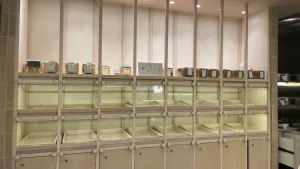
Image: Empty Shelf in Kooma Bakery Due to the Big Enthusiasm from the Buyers
To provide the authenticity of the Japanese atmosphere, Damien and his team designed the store with natural materials like stone, wood, and pebbles. Initially, he wanted a cave-like entrance, but the mall did not allow it due to height restrictions. For authentic Japanese taste, Damien imported some critical material like matcha, flours, nori flakes, and azuki beans directly from Japan.
Experience with Singapore Association in Indonesia
In terms of expanding his business overseas, Damien thought that having a community in a sense is really important because at least there are people that you can go and look for to understand the local culture better. During his first year in Indonesia, Damien had some meetups with fellow Singaporeans in Indonesia. He invited some of them to the cafes to hear about their opinions about business.
Damien also found that the SAI group chat in the WhatsApp definitely very helpful for him because the members used to exchange information al the time. He told us, “So if I need something, whether it’s a specific supply or I ask about location, they will help out. Even some will go into actual partnership, like someone I know from the group also helping me with the logistics. Exchange what we understand about the market, whether it’s suppliers, whether it’s market, whether it’s location. It has helped to that extent. Every time we open new outlet, especially new brands, I make it a point to invite them to come down also to try, give some feedback. Yesterday, we just met someone in the consultant. He was helping me with some notary stuff as well.”
Advice for Singapore Entrepreneur Who Want to Enter Indonesia Market
To conclude the interview, we asked Damien to share about some tips and advice for his fellow Singaporean entrepreneur that wanted to expand to Indonesia.
- Remember you are not competing in a home market anymore, but it’s a global marketplace
Damien highlighted how the boundaries between countries are not so clear like they used to do because all the worldwide brands are going everywhere and getting displaced. So, it is important to remember that we are competing in a global marketplace. He stated, “You have to think of the aspect to even just to survive. So let’s start there as the first thing.”
2. Think of business that suitable to go overseas
Not all business are suitable to bring overseas because it is a whole different market than Singapore. Damien pointed out how some Singaporeans look at their business from inside-out. He gave a brief example from his experiences, “When you go to a market, it should be very outward. Look at the macro picture. In this market, what do I think is suitable down here? Then I go backwards to the product. Not like I have this product, I look at the cost down here, then I’ll do the markup and put the pricing down here.
3. Build your network
Different from Singaporeans that really straightforward, Indonesian are more based on a close relationship. That is why Damien emphasizing to build network in Indonesia and to be more flexible instead of strict person.
About Damien Koh
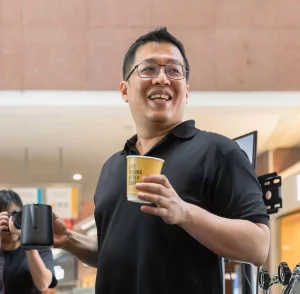
Damien Koh is a Singapore-based entrepreneur best known for founding Joe & Dough and Kooma Bakery, building innovative brands across Singapore and Indonesia.
Lionel Kwik: Former Businessman Who Choose To Became A Fulltime Pastor
Leading with Purpose: Pastor Lionel Kwik’s Journey of Run Business and Serve the Church in Indonesia
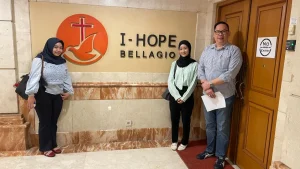
Image: Lionel Kwik & SAI Team at I-HOPE Church Bellagio
Lionel Kwik always has a close-ties with Indonesia. Even though he is a Singaporean citizen, he was born from parents who were both born and raised in Indonesia. His father was born in Jogjakarta and her mom was born in Semarang. So, how did this closeness affect his life choice in business and to serve God in Indonesia later?
Before stepping fully into ministry, Lionel built his life around business. He had grown up in a family deeply rooted in trade, working closely with his father whose work connected him to various sectors, from aviation to marine equipment. Indonesia was always part of the landscape of his business journey. Even though he held Singaporean citizenship, his parents, both born in Central Java, gave him a natural cultural bridge that made Indonesia feel familiar and personal.
But the shift from business to ministry was not sudden. It was a calling planted early in his teenage years—spoken over him by pastors who saw something in him that he himself could not yet imagine. “God is calling you to serve full-time,” they said. Lionel carried those words quietly for years, long before he ever acted on them. In Singapore, he served faithfully, mentored by leaders at Grace Assembly, and eventually made what he calls “a transition led by timing, not by planning.”
The transition intensified when he moved to Australia for theological studies. He uprooted his entire family. He pursued a degree in Biblical Studies. It was a season of stretching and clarity. He served in a church in Australia, experienced different leadership cultures, and learned what a faith-driven life could look like outside of Singapore’s structure and speed.
Ironically, he expected to stay in Australia after graduation. The church hoped for it. He thought perhaps, like other Singaporeans, he might migrate there. Yet in the final month of his studies, immigration laws suddenly changed. He no longer qualified for a religious worker visa. “Just like that, I had to pack everything,” he recalled. In January 2016, he shipped his belongings back to Singapore with no clear next step.
And that was when Indonesia called. Literally.
H. B. L Mantiri, someone who had known Lionel for over twenty years, phoned him and said, “I think you need to come over here. We need someone to organise the church.” The church in Jakarta needed restructuring: administration, legal documents, even the basics like bank accounts under the proper church name. Lionel flew over, expecting it to be a short two- or three-year assignment.
“Now it’s been almost ten years,” he said with a soft laugh, “and what an experience it has been.”
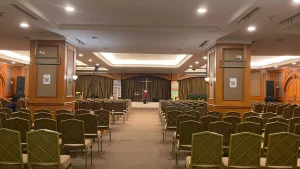
Image: Inside the GSJA Bellagio Church
Learning to Lead in a Different Culture
Being a church leader in Indonesia, Lionel found, was a completely different world from pastoring in Singapore or serving in Australia. Indonesia’s religiosity is woven into daily life. The needs are different too. In countries like Singapore, social infrastructures are strong, leaving fewer gaps for churches to fill. In Indonesia, churches often become social lifelines, supporting those whom the system does not reach.
The congregation he leads is English-speaking, yet diverse: Indonesians, East Asians, and many Europeans. Managing such a mix requires cultural humility and constant adaptation. Lionel shares how surprised people often are when he speaks fluent Bahasa Indonesia, or when he uses local phrases like “aku pamit dulu”—a gesture that feels natural to him but unexpected from a Singaporean pastor.
Cultural adaptation, he says, is not optional. It is ministry.
“You can hold on to your values, integrity, honesty, structure,” he explained, “but you cannot impose your timetable on Indonesia.” He often counsels Singaporean companies entering the market to adjust their expectations. Things move differently here. Timelines shift because of public holidays, sudden decrees, cultural habits, or simply the rhythm of life.
Why Ministry Became His Life’s Purpose
For Lionel, the decision to leave business behind was not because business lacked meaning. It was because ministry required his whole heart. “I cannot do both,” he said firmly. “As a pastor, you must guard your integrity. Business will put you in situations that compromise that.” He had seen how easy blurred lines could become. His philosophy was simple: business and church must remain separate.
In his own years as a businessman, he relied on principles rather than shortcuts. He avoided practices that lacked integrity, delegated ethically questionable matters to local partners, and built a career that reflected his personal values. But once his children were grown and his career stable, he knew it was time to fully answer the calling planted decades earlier.
Now, after years of serving in Indonesia, Lionel sees his journey not as a series of coincidences, but as a divine orchestration. A closed door in Australia opened a path to Jakarta. His Indonesian heritage gave him cultural insight. His Singaporean upbringing gave him structure. His business experience gave him leadership. All roads, it seems, prepared him for this role.
The Singaporean Community: Finding Familiarity Abroad
Although he had extended family across Jakarta, Lionel eventually found his way into the Singaporean community through the simplest encounter: over a bowl of bakmi at Pasar PIK. He heard the unmistakable rhythm of a Singapore accent at the next table. A quick conversation turned into an invitation into the Singapore Association in Indonesia group chat, which later connected him to gatherings, National Day events, and fellow Singaporeans living across the city.
The community didn’t help him “settle” into Indonesia because he had already felt settled, but it offered familiarity. It provided space to celebrate shared culture: Chinese New Year dinners, National Day receptions, casual meetups, and holiday gatherings.
Advice for Businesspeople Feeling Called to Ministry
When asked what advice he would give to businesspeople who feel a spiritual calling, Lionel’s answer is simple and practical:
“Get involved with the church first.”
He believes calling does not begin with grand gestures, but with serving in small spaces by showing up, participating, observing, and allowing God to shape one’s heart over time. His own journey took decades to unfold, moving through business, family responsibilities, cross-cultural transitions, and divine redirection.
Behind his story is a quiet conviction: purpose is not a sudden revelation but a steady response.
And Lionel Kwik’s life spanning business, migration, ministry, and service shows what it looks like to answer that call, one faithful step at a time.
About Lionel Kwik
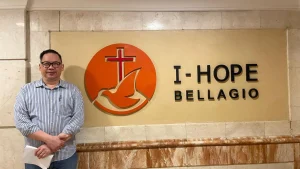
He has served as the Lead Pastor of I-HOPE Bellagio since July 2016, following earlier years of ministry in Perth, Australia, where he completed his theological training with a Bachelor of Ministry and received his first ordination as an Associate Pastor. Before entering full-time ministry, Pastor Lionel built a career in the marketplace, working in property investment, banking and finance, and later managing his own import–export business specializing in aviation and marine equipment.